Showing posts with label baby animal. Show all posts

Friday, November 2, 2012

Snakes are cute, not slimy!

For Hallowe'en, I'm profiling animals that are not normally considered cute. In fact, many people are often afraid of these animals, and I'll be showing how cute they can be.

Although Hallowe'en has ended, I'm still celebrating with another Hallowe'en party this weekend. Here is the last animal in my Hallowe'en series: Snakes!
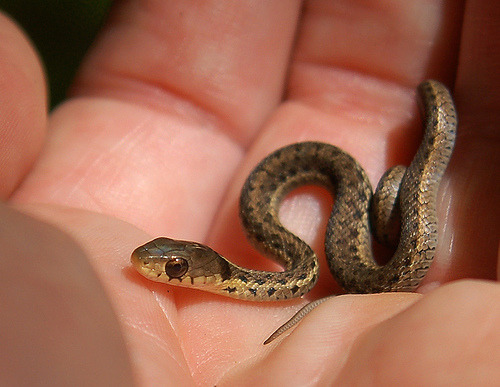
So tiny!

Baby snakes can be really tiny! And tiny things are usually cute. :) Snakes are Reptiles, which means that they cannot warm themselves. Instead, they have to find warm places, like a sunny rock, to lie on. If Reptiles become too cold they cannot move! So, if you are considering a Reptile as a pet, remember that you must provide a heat source, like a heat lamp, so that your cute friend can stay cozy


Keeping the babies warm.

Most Snakes lay eggs to have babies, although many Snake parents do not watch over their eggs. One species, the Python, does stay close by to keep their eggs warm and safe. They wrap their long bodies around the eggs, to incubate them, which means to keep them the right temperature. 

There are a few Snakes who don't lay eggs, and instead give birth to live snakes! 


Snakes are not slimy, like a lot of people think. Snails and Slugs are gooey, but Snakes are smooth and soft. They shed their skin a few times a year, called molting, which is a way of getting rid of any parasites, and leaves behind brand new skin!

Tuesday, July 10, 2012

Baby Skunks!

A few days ago I discovered that there are seven baby Skunks living on my street in Vancouver! They live in a cute burrow with their parents, but are often out and about in the evening, playing with one another. Here's a little video of them:


Baby Skunks! from Nico Collins on Vimeo.

Look at those holes the Skunks made!


Skunks are known for their ability to spray a smelly liquid when threatened, but Skunks don't often spray! If you get close to a Skunk, it will hiss at you before spraying you, so don't be afraid of them, but do keep a respectful distance. Skunks also don't have great eyesight, so unless you get super close, they probably cannot even see you.


Digging for worms!

Skunks dig burrows to live in, where they cuddle with their family, and also dig in the ground to find food, like wormies. These baby Skunks are still pretty small, but very active in playing with one another and digging a lot! Skunks had tiny little legs with claws, long bodies, and of course, a big pouffy tail. Skunks eat a lot more than just worms, and in fact, will eat almost anything! They are not very picky eaters.


3 baby Skunks hanging out together.


Skunks sleep during the day and wake up around sunset to look for food. In Vancouver, I usually see adult Skunks in the nighttime, around midnight, but the babies are active starting around 8pm. Skunks also sleep more and eat less in the Winter, although they don't usually hibernate, like some bears. Sometimes, many lady Skunks will sleep in a den together to stay warm!


Thursday, January 5, 2012

A Special Post for my Hamster, Little Panda.

I have sad news: on December 24th, my Syrian/Teddy Bear Hamster, named Little Panda, passed away due to a stroke. He was an adorable, fuzzy, little creature who liked running on his hamster wheel and nibbling cute food.


April 2nd, 2011


This is Little Panda on his first day in my home. He was only a few weeks old and was very tiny, and a little apprehensive. He shred the newspaper into little tiny bits to make a comfy nest for himself.


Little Panda's First Adventure


After a couple of weeks of getting to know Little Panda, I let him venture out of his cage to explore my living room. He was very excited and ran very quickly around! Hamsters are very good runners.


Me and Little Panda :)


Little Panda also liked to climb on me! The sweater I'm wearing has deep pockets that he liked to explore.

In the wild, Syrian Hamsters are active at dawn and dusk, when they awake to run around and collect food. Pet Hamsters are often active all throughout the night because they have no predators to hide from.


Little Panda climbing


Hamsters are Rodents and are related to Mice, Rats, Squirrels, and Beavers. They are great climbers as seen in this photo of Little Panda! He loved to climb all over his cage and had little tiny feet with claws to grip on tightly.


A New Cage!


When I moved into a bigger house in May, I set about building a big cage using old window screens that I found on the sidewalk. I decorated the inside with grass and pebbles, and also made a really cool house for him with medium-sized rocks. It had multiple entrances and levels because Hamsters like to be protected. In the wild, Syrian Hamsters are considered "vulnerable" because people are starting farms on the land where these fuzzy guys live.

I fed Little Panda grains, fruits, vegetables, seeds and some treats of cheese and milk. Hamsters have special cheek pockets that they store food in, which makes their face look really chubby and cute!

In September, I embarked on a cross-Canada adventure. I got Little Panda a new travel cage with a wooden house, a water dispenser, and lots of privacy. He traveled with me on the train across all the provinces (except P.E.I), making him a very well-educated and cultured little Hamster.

Little Panda was buried in a cute park on the beach on Salt Spring Island, close to a farm with Alpacas and Sheep. I think this will be a quiet and nice place for him.

Monday, August 29, 2011

Llama Llama!


 A few weeks ago I visited a petting zoo at Lester's Farm! There were a bunch of adorable animals such as, bunnies, baby goats, sheep, cows, baby chicks, a pig, but my favorite of all was the baby Llama!


Baby Llama!


A baby Llama is also called a "cria", which is the Spanish word for "baby". Llama moms are pregnant for about 11 months and stand up while giving birth. The baby Llama can usually walk and eat within an hour of being born!


I was very excited to meet this baby Llama! I pet him and his fur was super fuzzy and soft. I also fed him some grass, which is one of their favourite snacks.


Mommy and Baby Llama!


Llamas like to be around lots of other Llamas! These animals are domesticated, meaning there are no wild Llamas. They are related to camels and were domesticated from a wild camel called a "Guanaco".

Saturday, May 28, 2011

Baby Owls!

This is a special post for Marie-Claire, who suggested baby owls.


Cuddle cuddle.


Owls are found almost everywhere in the world, except Antartica and parts of Greenland. These cute birds have big, round eyes, for seeing at night. Owls can rotate their head almost all the way around in a circle!  This helps owls see because they cannot move their eyes from side to side.


Cute little owly hiding in a tree.


Most owls spend their time by themselves, and are usually active at night. They sleep all day and wake up at night to catch rodents and little birds. There are a few owls that fly around in the day, and some that are most active around dawn and dusk.


Some owls have special feathers that make the bird's flight silent! The edges of some of their feathers are jagged, which reduces the noise from the flapping wings. This means that they can sneak up on their food!


Saturday, March 5, 2011

Baby Pygmy Animals!

Since I've become unemployed, I have so much more time to update my blog! 

Today's post is about pygmy animals, which are tiny versions of big animals, making them extra cute!

Maybe one day I'll pet a baby pygmy hippo!


A baby pygmy hippo! 

These hippos live in Africa in forests and swamps. They mostly keep to themselves and are more active in the night (nocturnal). Like bigger hippos, they like living in the water, and will sometimes give birth there. 


These adorable little hippos love munching on grass and fruit. They sneak out of their river hiding spot around dusk to eat. Sometimes pygmy hippos sleep in dens or burrows in the river bank. Although, no one knows if the hippos actually make these homes themselves.


So tiny!
A baby pygmy tarsier!

Pygmy tarsiers were thought to be extinct since the 1920's until recently in 2008 when these cute little animals were rediscovered. 

They are nocturnal primates who live in Indonesia and are only about 9 to 10 cm long!

They have long tails and nails on their teensy hands for gripping onto trees. Tarsiers nibble on insects and sleep vertically in trees during the day.


Pygmy Marmosets are the smallest monkeys in the world (although pygmy tarsiers are tinier, but are not monkeys, just primates). They are abut 14 to 16 cm in length! These tiny monkeys makes their homes in the rainforests of Brazil, Colombia, Ecuador, Peru, and Bolivia.


Pygmy marmosets use different whistles and calls to talk to family members. Sometimes these calls give warnings of approaching danger.


These super adorable monkeys eat insects, fruit, tree sap, and leaves.


Pygmy goats are originally from West Africa and have since been domesticated. 


These mini goats like chewing on grains and grasses. 


They live for about 10-15 years and are very popular as household pets or in petting zoos. 

LinkWithin

Related Posts Plugin for WordPress, Blogger...